How do I say I'm vegetarian or have a food allergy in Japan?
Saying you are vegetarian is not enough, and the reason is dashi — fish stock, usually dried bonito, which is in most savoury Japanese food including the vegetable dishes. It is not thought of as meat, so it does not come off the plate when you say you do not eat meat. Ask about it separately, in writing, before the food is cooked.
The ritual, in order
How to make a restriction actually land
Decide which one you are saying: a preference or an allergy
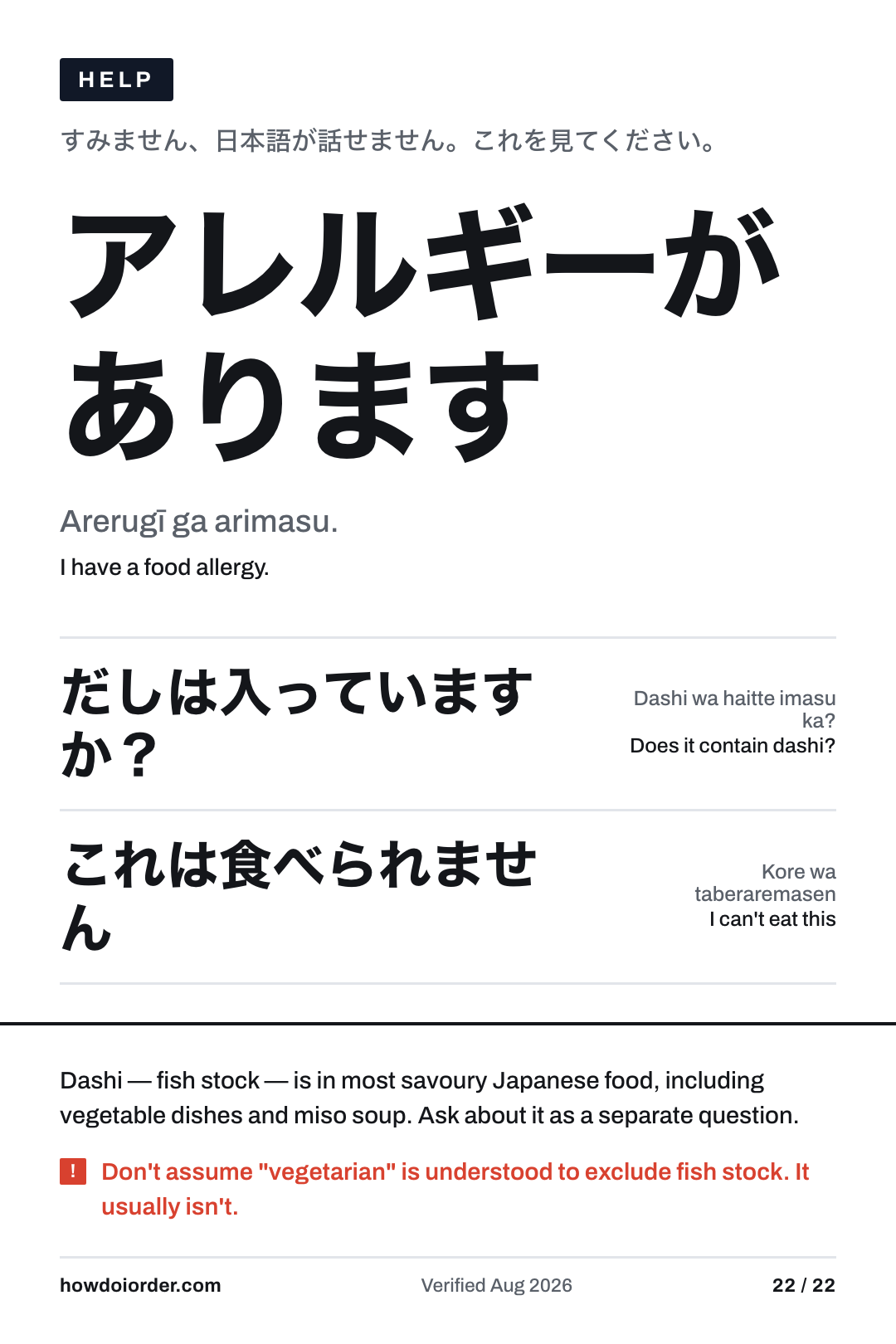
They are handled completely differently. A preference (bejitarian desu) is treated as a taste and gets a friendly guess. An allergy (アレルギー, arerugī) is treated as a safety matter and gets the question taken to the kitchen. Say the true one — but know which door you are knocking on.
Say it before you order, not after the food arrives
Say it when you sit down, or at the door before you are seated. Most Japanese kitchens build dishes from a stock that was made this morning, so a substitution is a decision about the whole dish, not about one ingredient lifted off the top. Once it is plated, nothing can be done.
Show it written down rather than saying it
Pointing at a card in Japanese is dramatically more reliable than speaking. It removes your accent, it removes their listening comprehension, and it can be carried into the kitchen and shown to the person who is actually cooking. Speaking gets you a nod; paper gets you an answer.
Ask about dashi as a separate question
This is the step everything else hangs on. だしは入っていますか? — dashi wa haitte imasu ka?, does it contain dashi? Ask it about every dish, including the ones that are visibly only vegetables. Answering it is easy for staff; guessing that you wanted to know is not.
Name the ingredient, not the category
Categories translate badly. Niku (meat) is often heard as beef and pork, so no meat can still arrive with ham, bacon or chicken in it. 肉も魚も食べません — niku mo sakana mo tabemasen, I eat neither meat nor fish — closes most of that gap. For an allergy, name the exact food: tamago arerugī desu.
Have a fallback you already know works
If the answer is a hesitation, leave. A hesitating kitchen is a kitchen that is about to guess. Temple cuisine (shōjin ryōri), an Indian restaurant, or a convenience store with a labelled packet all beat a well-meant guess.
What they will ask you
Four questions you will get back, and what to answer
These come back fast and are meant kindly. The last two are the ones worth rehearsing — they are the point at which a kitchen decides how carefully to treat you.
| You’ll hear | It means | Say |
|---|---|---|
| 何のアレルギーですか?Nan no arerugī desu ka? | What are you allergic to? | 卵ですTamago desu — eggs |
| ベジタリアンですか?Bejitarian desu ka? | Are you vegetarian? | はい、肉も魚も食べませんHai, niku mo sakana mo tabemasen — yes, no meat and no fish |
| だしは大丈夫ですか?Dashi wa daijōbu desu ka? | Is fish stock all right? | いいえ、食べられませんIie, taberaremasen — no, I can't eat it |
| 少しなら大丈夫ですか?Sukoshi nara daijōbu desu ka? | Is a small amount all right? | いいえ、少しでもだめですIie, sukoshi demo dame desu — no, not even a little |
Dashi
The one fact that explains every failed vegetarian meal in Japan
Dashi is the stock that most savoury Japanese cooking is built on, and the standard version is made from katsuobushi — dried, smoked, shaved bonito — often with kelp. It is in miso soup. It is in the simmered vegetables, the tempura dipping sauce, the noodle broth, the rolled omelette, the rice seasoning and the sauce on the tofu. A plate that contains no visible animal has very often been cooked in fish.
The problem is not that anyone is careless. It is that dashi is filed mentally as seasoning rather than as an ingredient, in the same way stock cubes or fish sauce slip past elsewhere. So bejitarian desu — I am vegetarian — is heard as a statement about meat, and the vegetable dish that arrives is, from the kitchen's point of view, exactly what you asked for. Nobody has lied to you.
This is why dashi has to be its own question: dashi wa haitte imasu ka? There is a kelp-only version (kombu dashi) and some kitchens keep it, so the answer is occasionally a straightforward yes. Ask it plainly and early, at an izakaya as much as anywhere else, and accept a no as useful information rather than as a defeat.
Don't assume the word vegetarian excludes fish stock — it usually does not, and the vegetable dish that comes back will have been simmered in bonito by a kitchen that thinks it has done exactly what you asked.
If it is an allergy
Where a phrase from a website stops being enough
Be plain about the line here. If your allergy is severe — if a trace can put you in hospital — a phrase copied off a page like this one is not the tool for the job. Carry a properly translated medical card, written or checked by someone qualified, naming the allergen and what happens, and carry your own adrenaline autoinjector. Know that the emergency number is 119 and that it covers ambulance as well as fire. This page can get you a careful answer in a restaurant; it cannot make a kitchen safe for you.
For everything short of that, the practical fact is that the word arerugī changes the behaviour of the room. A preference gets a friendly best effort from the person in front of you; an allergy gets walked into the kitchen and asked. Add the exact food and, if it is true, sukoshi demo dame desu — not even a little — which is what tells staff you are not asking them to reduce it. Do not claim an allergy you do not have: it is the reason the word still works.
Every ritual on this page is dated, and the cards carry the month they were checked. Japan changes these details more often than guidebooks admit — machines get replaced, charges get added, rules get relaxed.
Questions
The questions people ask before their first meal
What is the actual sentence for I am vegetarian?
Bejitarian desu (ベジタリアンです) is understood everywhere, but on its own it mostly buys you a dish without visible meat. Add niku mo sakana mo tabemasen (肉も魚も食べません) — I eat neither meat nor fish — and then ask about dashi separately. Three seconds of extra speech does most of the work on this page.
Which everyday dishes have hidden fish in them?
Assume miso soup does unless told otherwise, and the same for simmered vegetables (nimono), tempura dipping sauce, most udon and soba broth, savoury egg custard, oden, and okonomiyaki, which is usually finished with bonito flakes on top. Ask dashi wa haitte imasu ka? about each of them rather than assuming a green dish is safe.
Is there anything reliably free of animal products?
Shōjin ryōri (精進料理), Buddhist temple cuisine, is the genuinely reliable option: it excludes meat, fish and fish stock by religious rule rather than by request, and uses kelp and shiitake for stock instead. It is served at temples and specialist restaurants, is usually a set course, and typically runs ¥3,000–¥6,000 at lunch. Book a day ahead — most take reservations only.
Does saying allergy really get a different answer?
Materially, yes. Arerugī ga arimasu (アレルギーがあります) is understood as a safety statement and usually results in someone going to the kitchen rather than answering from memory; chain restaurants often keep a printed allergen chart at the till for exactly this. A preference gets a well-meant guess. Say whichever is true.
How do I read an ingredients label?
Find 原材料名 (genzairyōmei), the ingredients line, and look at the bracket at its end where allergens are listed. Japan mandates labelling for a short list — 卵 egg, 乳 milk, 小麦 wheat, えび shrimp, かに crab, そば buckwheat, 落花生 peanut, with くるみ walnut added in a change phased in through 2025. Photograph the panel and translate it rather than reading it in the aisle.
What can I safely buy at a convenience store?
Plain rice balls are the workhorse — ume (pickled plum) and kombu (kelp) fillings are usually animal-free and cost ¥130–¥180 — along with edamame, plain natto, fruit, nuts and inarizushi. Tuna mayo and salmon look similar and are not. The full run of the shop is on the convenience store page; check the label rather than the picture.
I said no meat and got ham. Why?
Because niku is commonly heard as beef and pork. Ham, bacon, chicken, and anything treated as a topping or a garnish can survive the instruction, and bonito flakes almost always do. Naming what you cannot eat — niku mo sakana mo tabemasen — works far better than naming a category, and showing it in writing works better still.
Is a phrase from this page enough for a severe allergy?
No. For anaphylaxis-level allergy, carry a translated medical card prepared or checked by a medical professional, carry your autoinjector, and tell staff before you order rather than after. The emergency number in Japan is 119 for an ambulance. Pharmacies cannot replace a prescription autoinjector — see buying medicine in Japan for what a drugstore can and cannot do.