How does tax-free shopping work in Japan?
You need the actual passport in your hand, not a photo of it. Above a minimum spend at one shop on one day, the shop takes the consumption tax off at the till or at a central tax-free counter. Food, drink and cosmetics get sealed in a bag you must not open until you have left the country.
The ritual, in order
What happens at the counter, in the order it happens
Carry the passport itself
Not a photo, not a photocopy, not the hotel's scan, not the picture in your phone. The staff member scans the passport, and a residence card or a driving licence will not do instead. If yours is locked in a hotel safe, today is not the day.
Say it before they ring anything up
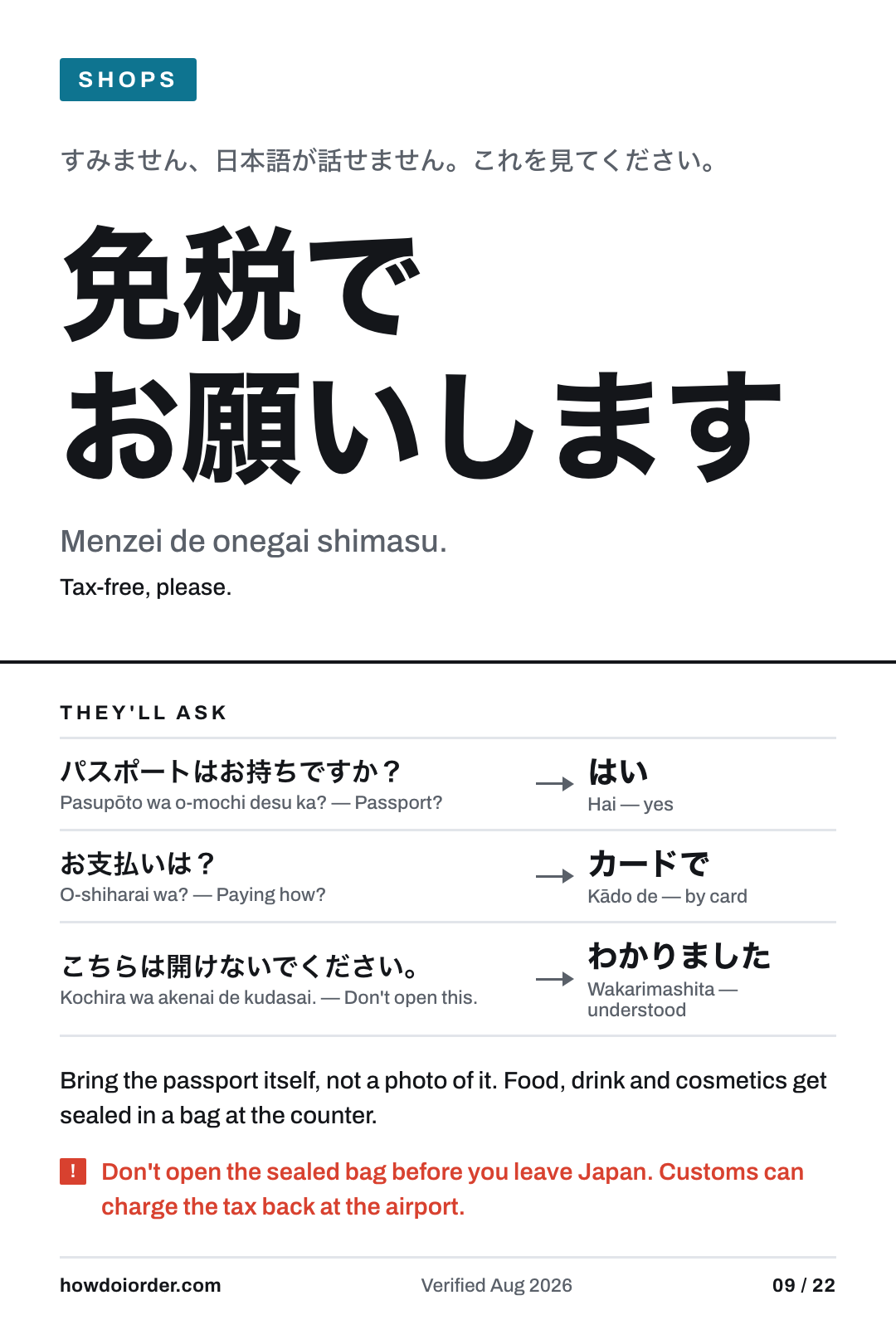
免税でお願いします — menzei de onegai shimasu, tax-free please. Asking after the sale has gone through means it usually cannot be undone, and in some shops it means a full refund and a second purchase.
Find out whether it happens at the till or at a counter
Drugstores and electronics chains normally do it at a dedicated till. Department stores usually do not: you pay the full price downstairs, then take the receipt, the passport and the card you paid with to a tax-free counter on a set floor, often with a small handling fee of around one per cent.
Watch which bag things go into
Consumables — food, drink, cosmetics, medicine — get sealed in a clear bag with tape. General goods such as clothes, bags and electronics do not. The two categories have had separate minimum spends, so a basket that mixes them may not add up the way you expect.
Keep the record with the passport
The paperwork is electronic — the purchase record is attached to your passport rather than stapled into it. You are not required to carry a slip, but keep the shop receipt anyway; it is what settles an argument at the airport.
Expect to be asked at departure
Customs can ask to see the goods before you check in, and can charge the tax back if a sealed bag is open or the items are not with you. Pack tax-free consumables where you can reach them, and allow an extra fifteen minutes if you bought a lot.
What they will ask you
Four lines you will hear at the tax-free desk
The staff at a tax-free counter deal with visitors all day and will keep it short. These four cover it.
| You’ll hear | It means | Say |
|---|---|---|
| パスポートはお持ちですか?Pasupōto wa o-mochi desu ka? | Do you have your passport with you? | はいHai — yes |
| お支払いは?O-shiharai wa? | How are you paying? | カードでKādo de — by card |
| こちらは開けないでください。Kochira wa akenai de kudasai. | Please don't open this one. | わかりましたWakarimashita — understood |
| 免税カウンターは5階です。Menzei kauntā wa go-kai desu. | The tax-free counter is on the fifth floor. | ありがとうございますArigatō gozaimasu — thank you |
The threshold
The number on this page has a date on it
The rule for years has been a minimum of ¥5,000 before tax, spent at one shop on one day, with consumables and general goods counted separately and an upper limit on how much food and drink could go through. Japan has legislated changes to the tax-free scheme, the categories and thresholds have moved more than once, and implementation dates have slipped before.
So do not trust the number in the paragraph above, and do not trust the travel article you read before it. Every participating shop has the current terms printed on a sign at the tax-free counter, in English, usually within a metre of where you will be standing. That sign is correct on the day you are there. This page carries the month it was written and cannot be.
What is stable enough to plan around: you need the physical passport, you need to be a short-stay visitor rather than a resident, it is one shop on one day rather than a total across the trip, and it applies to goods you take out of the country and not to meals, hotels or transport.
Don't open the sealed bag before you leave Japan. Customs can charge the tax back at the airport, and the tape is designed so that they can see you did it.
Before you rely on this
Why the counter beats the article
Every ritual on this page is dated, and the cards carry the month they were checked. Japan changes these details more often than guidebooks admit — machines get replaced, charges get added, rules get relaxed.
Tax-free is the part of this site that moves fastest, because it is set by legislation rather than by habit. A ritual like the small tray at the register has been the same for decades. A tax threshold can change with a budget, and the shift from an exemption taken at the till to a refund collected on departure has been on the table for some time.
The practical version: assume the passport requirement and the sealed bag hold, treat every figure as provisional, and read the sign. If the total is close to the line, the staff member will tell you what you are short by before they ring it up — that is a normal conversation and worth having, because the saving on a ¥30,000 purchase is about ¥3,000.
Questions
The things people ask at the till
How much do I have to spend?
The long-standing floor has been ¥5,000 before tax at one shop on one day, with consumables and general goods counted as separate baskets. Treat that number as provisional — it has moved before — and read the sign at the tax-free counter, which is the only version that is current on the day you are standing there.
Do I really need the physical passport?
Yes. A photo on your phone, a photocopy and a hotel scan are all refused, because the staff member scans the document itself. Plan your shopping days around carrying it, and put it back in the safe the evening you are done — losing it costs far more than the ¥3,000 you saved.
How much do I actually save?
Consumption tax is 10 per cent on most goods and 8 per cent on food and drink, and Japanese price tags usually include it. So a ¥33,000 sticker price comes down to about ¥30,000, and a ¥5,500 one to about ¥5,000. On a department store purchase, subtract the handling fee of around one per cent from that.
What is the sealed bag, and can I open it?
Consumables — food, drink, cosmetics, medicine — are taped into a clear bag at the counter, and the staff member will say kochira wa akenai de kudasai, please don't open this one. It stays shut until you have left Japan, and customs can charge the 8 to 10 per cent back if you open it early. Expect to pay the tax on the whole bag, not the one item you wanted.
Why did the department store send me to another floor?
Because large stores centralise it. You pay the full marked price at the department till, then take the receipt, your passport and the card you paid with to the tax-free counter, usually on a named floor. Allow 15 to 20 minutes in peak season — the queue there is longer than the one at the till.
Does it cover my hotel, meals or train tickets?
No. The scheme is for goods you carry out of the country, not for services, so a restaurant bill and a hotel night both carry the tax regardless — see paying the bill. A ¥12,000 dinner is a ¥12,000 dinner, and there is no tipping on top of it either.
Can I do it at a drugstore or a convenience store?
Drugstores are one of the most common places for it and normally have a signed tax-free till — see the pharmacy page for what sits behind the counter. Some larger convenience stores in tourist areas do it too, though a ¥5,000 basket in a konbini is a lot of onigiri.
What happens at the airport?
Customs may ask to see the goods before check-in, so keep sealed consumables in your hand luggage where you can reach them. If they are already in a checked bag, or the seal is broken, you can be asked to pay the tax there and then. Build in an extra 15 minutes if you shopped heavily.